
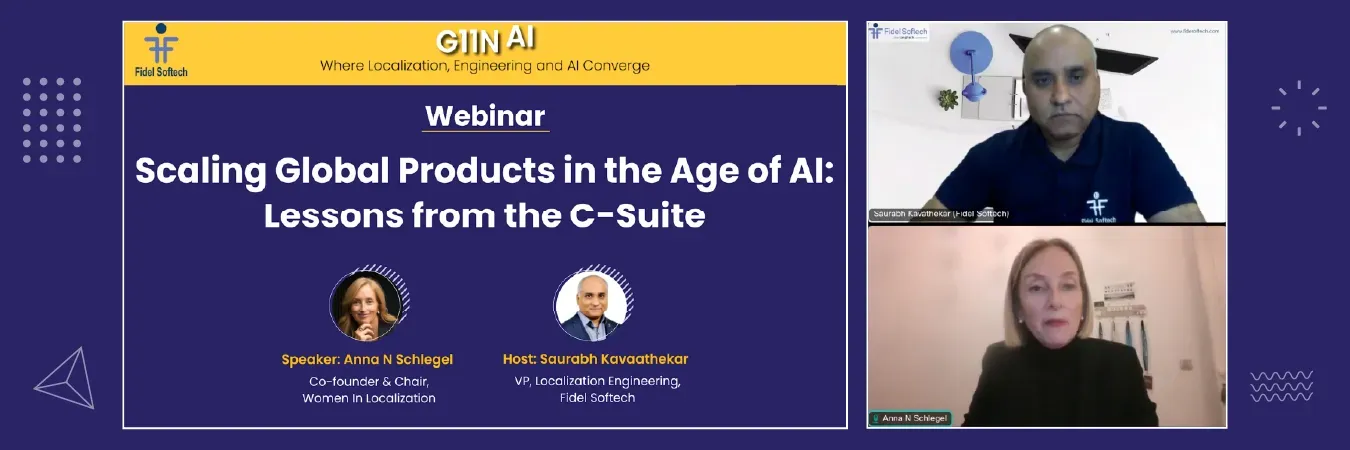
Fidel Hosts Insightful Webinar on “Scaling Global Products in the Age of AI”
27/01/2026
Fidel successfully hosted its latest G11N AI webinar titled “Scaling Global Products in the Age of AI: Lessons from the C-Suite” on Monday, January 26, 2026. The live online event brought together global localization leaders, product strategists, and AI practitioners to explore how artificial intelligence is transforming the localization and scaling of software products across diverse markets.
This one-hour “Scaling Global Products in the Age of AI: Lessons from the C-Suite” webinar, part of Fidel’s acclaimed G11N AI series, focused on the intersection of AI, localization engineering, and global product strategy. With rapid digital transformation and agile development cycles now the norm, traditional approaches to localization are often stretched beyond capacity. The session provided actionable insights on how organizations can accelerate international expansion by harnessing AI-driven workflows, engineering-first strategies, and human-machine synergy.
The “Scaling Global Products in the Age of AI: Lessons from the C-Suite” webinar featured Anna N. Schlegel, Co-founder and Chair of Women In Localization, as the keynote speaker. With over two decades of experience leading enterprise globalization efforts at major technology companies and as the author of “Truly Global: The Theory and Practice of Bringing Your Company to International Markets”, Anna shared strategic perspectives on how AI is enabling organizations to flip globalization from a sequential afterthought into a first-class engineering priority.
Hosted by Saurabh Kavaathekar, Vice President of Localization Engineering at Fidel Softech, the “Scaling Global Products in the Age of AI: Lessons from the C-Suite” webinar underscored the importance of combining innovative technology with a strong growth mindset to unlock true global scale. As AI technologies become increasingly embedded into product development lifecycles, the discussion highlighted how organizations can balance speed with precision, enabling teams to deliver highly localized user experiences without compromising on agility or quality. Speakers also emphasized the need for cross-functional collaboration, early integration of localization into product strategy, and the role of AI in supporting smarter decision-making as companies expand into diverse global markets.
Key Insights from the Discussion
- Leadership goes beyond technology adoption
True leadership in times of change means guiding people through transformation—not just deploying new tools or platforms. Successful AI and globalization initiatives require empathy, clarity, and active engagement with teams. - Globalization rarely starts in the boardroom
Localization often gains visibility only after outcomes are achieved. It enters leadership conversations through impact—such as market launches that directly contribute to growth—rather than through tooling or defect-related discussions. - Outcomes drive influence, not processes
When localization demonstrates clear business results, it shifts perception from a support function to a strategic growth enabler. - Metrics matter—but transparency matters more
Metrics locked within localization teams limit influence. When performance data is transparent and shared across the organization, localization can collaborate upstream with product, research, and strategy teams. - Localization must move upstream to scale effectively
Transparent metrics and cross-functional alignment allow localization to participate earlier in decision-making, becoming a true partner rather than a downstream service. - Technology evolves fast, alignment drives growth
While tools and AI capabilities change rapidly, sustainable global growth depends on how well organizations connect strategy, people, and narrative. - The real work of globalization is human
Tools enable scale, but long-term success comes from aligning leadership vision, organizational culture, and global storytelling.
The discussion concluded with a reminder that while tools and technologies will continue to evolve at a rapid pace, sustainable global growth depends far more on how effectively organizations connect strategy, people, and narrative. Technology can enable scale, but it is leadership, cultural alignment, and clarity of purpose that make globalization stick. When teams share a common story and understand the “why” behind expansion efforts, organizations are better equipped to navigate complexity, build trust across markets, and turn global ambition into long-term impact.
For more information about Fidel and upcoming events, connect with us at sales@fidelsoftech.com.
Ref. No – FN01261142