
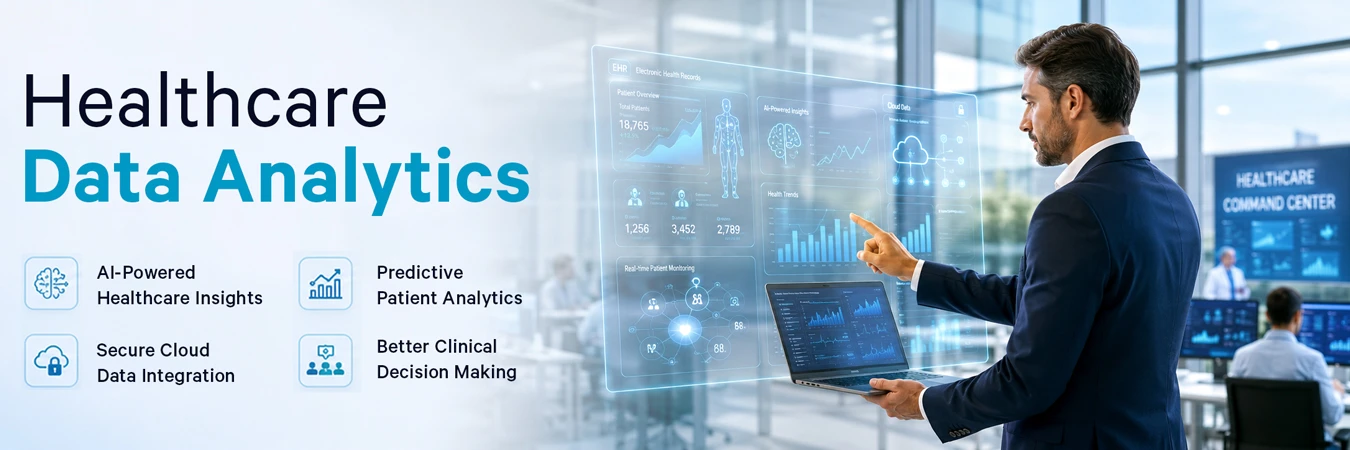
Healthcare Data Analytics: From Data Collection to Actionable Insights
Healthcare organizations generate vast amounts of information every day through electronic health records, medical devices, laboratory systems, insurance claims, patient portals, and wearable technologies. While this data holds tremendous potential, its true value lies in transforming it into meaningful insights that improve patient care, enhance operational efficiency, and support informed decision-making.
This is where healthcare data analytics plays a critical role.
As healthcare systems continue to embrace digital transformation, data-driven decision-making has become essential for improving clinical outcomes, optimizing resource utilization, reducing costs, and delivering personalized care.
Rather than simply collecting information, organizations are increasingly focusing on converting data into actionable intelligence that enables faster and more effective decisions.
In this blog, we explore the complete journey of healthcare data analytics—from data collection and integration to advanced analytics and actionable insights—and examine how organizations can maximize the value of their healthcare data.
Why Organizations Invest in Healthcare Data Analytics Services?
Healthcare data comes from numerous sources across clinical, operational, and administrative functions. Without a structured approach to managing this information, organizations often struggle with fragmented systems, inconsistent data, and delayed decision-making.
Healthcare data analytics services help organizations collect, organize, integrate, and analyze data from multiple systems to create a unified view of healthcare operations. These services support better decision-making by providing meaningful insights that improve both patient care and business performance.
Some of the key benefits include:
- Improved patient outcomes through evidence-based decision-making
- Better operational efficiency across healthcare facilities
- Early identification of health risks and disease trends
- Enhanced resource planning and utilization
- Reduced administrative burden
- Improved financial performance
- Better regulatory reporting and compliance
- Data-driven strategic planning
By converting raw healthcare data into valuable business intelligence, organizations can make faster, more informed decisions.
Understanding Data Analytics in Healthcare
Data analytics in healthcare refers to the process of examining healthcare-related data to identify trends, patterns, relationships, and insights that support clinical, operational, and financial decisions.
Healthcare analytics generally consists of four major categories.
1. Descriptive Analytics
Descriptive analytics focuses on understanding historical events by answering questions such as:
- How many patients visited the hospital last month?
- Which departments experienced the highest patient volume?
- What were the most common diagnoses?
It provides visibility into past performance and serves as the foundation for future analysis.
2. Diagnostic Analytics
Diagnostic analytics helps organizations understand why specific events occurred.
Examples include:
- Reasons behind increased emergency admissions
- Causes of delayed patient discharge
- Factors contributing to higher readmission rates
Understanding root causes enables healthcare organizations to address operational and clinical challenges more effectively.
3. Predictive Analytics
Predictive analytics uses historical data, statistical models, and machine learning to forecast future outcomes.
Common applications include:
- Predicting patient readmissions
- Identifying high-risk patients
- Forecasting disease outbreaks
- Anticipating resource demand
- Predicting equipment maintenance requirements
Predictive insights help organizations take preventive actions before issues arise.
4. Prescriptive Analytics
Prescriptive analytics recommends actions based on available data and predictive models.
Examples include:
- Optimizing treatment plans
- Improving staff scheduling
- Allocating hospital resources
- Enhancing patient care pathways
This enables better decision-making supported by data rather than assumptions.
The Data Journey with Healthcare Data Analytics Consulting
Implementing successful analytics requires more than collecting information. Healthcare data analytics consulting helps organizations establish structured processes that transform raw data into actionable insights.
Step 1: Data Collection
Healthcare organizations collect information from numerous systems, including:
- Electronic Health Records (EHRs)
- Laboratory Information Systems
- Medical Imaging Systems
- Pharmacy Systems
- Billing and Claims Platforms
- Wearable Devices
- Remote Patient Monitoring Systems
- Patient Feedback Platforms
The objective is to gather complete and accurate information from all relevant sources.
Step 2: Data Integration
Healthcare data often exists across disconnected applications and departments.
Data integration combines these diverse datasets into a centralized repository, making information more accessible for analysis while reducing data silos.
Step 3: Data Cleaning
Before analysis begins, healthcare data must be standardized by:
- Removing duplicate records
- Correcting inconsistencies
- Filling missing values where appropriate
- Standardizing formats
- Validating data quality
Clean data leads to more accurate analytics and reliable decision-making.
Step 4: Data Storage and Management
Organizations store integrated data in secure, scalable platforms such as cloud-based data warehouses or modern data lakes.
Effective data management ensures information remains accessible, secure, and ready for analysis.
Step 5: Data Analysis
Advanced analytical techniques are applied to identify trends and generate meaningful insights.
These may include:
- Statistical analysis
- Machine learning
- Artificial intelligence
- Predictive modeling
- Natural language processing
The goal is to uncover patterns that support better healthcare decisions.
Step 6: Data Visualization
Complex analytical findings are presented through dashboards, reports, and visualizations that allow healthcare professionals and executives to quickly understand performance indicators and make informed decisions.
Benefits of Choosing the Right Healthcare Data Analytics Provider
A reliable healthcare data analytics provider enables organizations to maximize the value of healthcare data while supporting long-term digital transformation.
Some of the major benefits include:
- Improved Patient Outcomes: Healthcare professionals gain access to timely insights that support accurate diagnoses, personalized treatment plans, and proactive care.
- Better Clinical Decision-Making: Real-time analytics provide clinicians with the information they need to make faster, evidence-based decisions.
- Operational Efficiency: Analytics helps identify workflow inefficiencies, optimize resource allocation, and improve overall healthcare operations.
- Financial Performance: Healthcare organizations can better monitor costs, revenue cycles, claims management, and reimbursement processes through data-driven insights.
- Population Health Management: Analytics enables organizations to identify disease trends, monitor public health indicators, and develop preventive healthcare strategies.
- Risk Management: Data-driven monitoring helps detect potential risks, improve patient safety, and support compliance initiatives.
- Strategic Planning: Executives gain access to accurate information that supports long-term planning, investment decisions, and organizational growth.
Common Challenges in Healthcare Data Analytics
Despite its advantages, healthcare analytics presents several implementation challenges.
- Data Silos: Information stored across disconnected systems limits visibility and slows decision-making.
- Data Quality: Incomplete, inconsistent, or outdated data reduces the effectiveness of analytical models.
- Interoperability: Healthcare organizations often use multiple platforms that do not communicate seamlessly with one another.
- Privacy and Security: Protecting sensitive healthcare information requires robust security practices, governance frameworks, and compliance with applicable regulations.
- Scalability: As healthcare organizations grow, analytics platforms must efficiently process increasing volumes of structured and unstructured data.
- User Adoption: Successful implementation depends on encouraging healthcare professionals to integrate analytics into everyday workflows.
Emerging Trends Shaping Healthcare Analytics
Healthcare analytics continues to evolve alongside advancements in digital technologies.
Some key trends include:
- Artificial Intelligence: AI-powered analytics improves diagnostics, clinical decision support, workflow automation, and predictive healthcare.
- Machine Learning: Machine learning algorithms continuously improve predictions by learning from historical healthcare data.
- Cloud-Based Analytics: Cloud platforms offer scalability, flexibility, collaboration, and secure access to healthcare information.
- Internet of Medical Things (IoMT): Connected medical devices generate real-time patient data that supports continuous monitoring and proactive care.
- Personalized Healthcare: Analytics helps healthcare providers tailor treatments based on patient history, lifestyle, and clinical data.
- Real-Time Analytics: Healthcare organizations increasingly rely on real-time insights to improve emergency response, patient monitoring, and operational decision-making.
Best Practices for Successful Healthcare Analytics
Organizations can maximize the value of healthcare analytics by following proven best practices:
- Define clear business and clinical objectives.
- Establish strong data governance policies.
- Improve data quality through regular validation and cleansing.
- Ensure interoperability across healthcare systems.
- Invest in secure and scalable infrastructure.
- Encourage collaboration between clinical, operational, and IT teams.
- Promote a data-driven culture throughout the organization.
- Continuously monitor and refine analytical models.
These practices help organizations build sustainable analytics capabilities that support long-term success.
Connect with Fidel for Data Analytics in Healthcare
Healthcare organizations are generating more data than ever before, but the true value of that data lies in how effectively it is collected, managed, analyzed, and transformed into actionable insights. By leveraging healthcare data analytics, organizations can improve clinical outcomes, enhance operational efficiency, support regulatory compliance, and make more informed decisions across every level of care.
As technologies such as artificial intelligence, machine learning, cloud computing, and predictive analytics continue to evolve, healthcare analytics will play an even greater role in enabling proactive care, optimizing resource utilization, and delivering personalized patient experiences. Organizations that invest in strong data strategies today will be better positioned to address future challenges and drive continuous innovation.
Fidel Softech supports organizations on their digital transformation journey by delivering scalable data analytics, data engineering, and modernization solutions that help unlock the full potential of healthcare data. With the right technology foundation and analytics capabilities, healthcare providers can turn complex data into meaningful insights that support better decisions and long-term growth. Connect with us at sales@fidelsoftech.com.
Ref. No – FB07261110
Related Blogs
A Smarter Power BI Alternative: Spoggle AI
The data analytics landscape is changing fast. Businesses that once relied on traditional BI tools like Microsoft Power BI are increasingly finding...

Choosing Between Outsourcing vs Staff Augmentation for Software Development
Are you looking to develop a software solution for your company but wondering whether to go for outsourcing vs staff augmentation? Then, let us tell...
Custom Accounting Software Development for Industry-Specific Needs
Custom accounting software development becomes essential when businesses rely on accounting systems that promise universal compatibility,...