
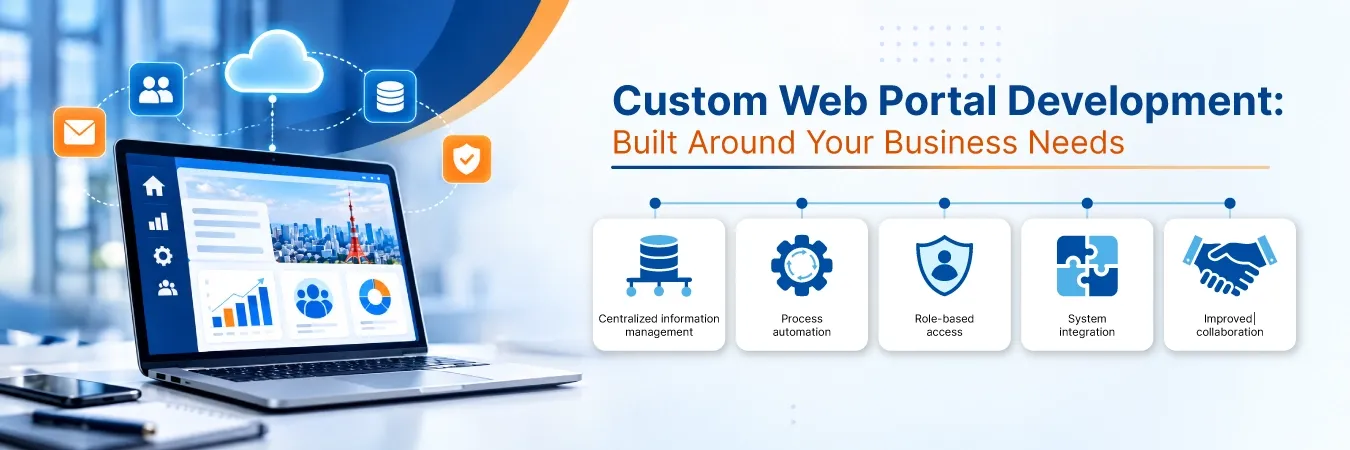
Custom Web Portal Development: Built Around Your Business Needs
Every business has its own way of working, managing information, and serving customers. However, standard software does not always accommodate every business requirement. As operations expand, managing multiple tools, disconnected systems, and manual processes can become challenging. Custom web portal development helps businesses address these gaps by creating centralized digital platforms designed around their specific workflows, users, and operational goals.
A well-designed web portal brings essential business functions together in one place. Whether it is managing customer interactions, coordinating employees, sharing information, or handling internal operations, a customized portal can make everyday processes more organized and accessible.
Why Do Businesses Need Customized Web Portals?
As businesses grow, their operational requirements become more complex. Teams may use different applications to manage projects, customer information, documents, and communication. Switching between these systems can affect productivity and make information management difficult.
A customized web portal provides a unified platform where users can access the tools and information they need. Instead of adapting business processes to the limitations of generic software, companies can build a solution that supports the way they actually operate.
Some common business requirements that can be addressed through customized portals include:
Centralized information management
Bring business data, documents, and resources together in one accessible platform.
Process automation
Reduce repetitive manual tasks through automated workflows.
Role-based access
Provide employees, customers, partners, and administrators with access to relevant information and features.
System integration
Connect existing business applications and databases to improve information flow.
Improved collaboration
Enable teams and stakeholders to communicate and coordinate activities through a shared platform.
Web Portal Development: What Makes a Portal Effective?
Effective web portal development involves more than creating a website with multiple features. It requires understanding how different users interact with the platform and what they expect from it.
A successful portal should offer a simple interface, easy navigation, reliable performance, and relevant functionality. The design and technical architecture should also support the organization’s current requirements while allowing room for future expansion.
Depending on business needs, a web portal may include:
- Customer portals: Allow customers to access services, submit requests, track updates, and manage their accounts.
- Employee portals: Provide access to internal announcements, HR resources, company documents, and employee-related information.
- Partner portals: Help distributors, vendors, and business partners exchange information and coordinate activities.
- Enterprise portals: Connect different departments, business applications, and operational resources through a centralized platform.
Selecting the right portal structure and features is important to ensure that the platform delivers practical value to its users.
What to Look for in Web Portal Development Services?
Choosing the right web portal development services is an important step in building a solution that meets business expectations. The development approach should begin with understanding the organization’s objectives, existing systems, user requirements, and technical environment.
A structured development process generally includes:
1. Requirement Analysis
The development team evaluates business workflows, identifies operational gaps, and defines the portal’s core requirements.
2. UI/UX Design
The interface is designed to make navigation simple and ensure that users can access important features without unnecessary complexity.
3. Development and Integration
The portal is developed with the required functionalities and integrated with relevant business applications, databases, and third-party systems.
4. Testing and Quality Assurance
The platform undergoes functional, usability, security, and performance testing to identify issues before deployment.
5. Deployment and Ongoing Support
After deployment, the portal can be monitored, maintained, and enhanced as business requirements evolve.
Following these stages helps businesses build a portal that is useful, reliable, and aligned with their operational goals.
How to Choose the Right Custom Web Portal Development Company?
Selecting a custom web portal development company requires looking beyond development costs and delivery timelines. Businesses should evaluate the company’s technical capabilities, project experience, development approach, and ability to understand specific business requirements.
Here are a few important factors to consider:
- Understanding of business requirements: The development team should be able to translate business challenges into practical technical solutions.
- Technology expertise: Experience with relevant programming frameworks, databases, cloud platforms, and integration technologies is important.
- Scalability and flexibility: The solution should accommodate additional users, features, and changing business requirements.
- Security considerations: Authentication, authorization, data protection, and access controls should be considered throughout development.
- Post-deployment support: Maintenance and technical assistance help ensure the portal continues to perform effectively.
The right development team should focus on building a solution that fits the business rather than simply delivering a standard set of features.
Why Choose Fidel for Custom Web Portal Development Services?
At Fidel, we understand that every business has different digital requirements. Our software engineering capabilities help businesses develop technology solutions aligned with their operational needs and long-term objectives.
Our custom web portal development services focus on creating functional, user-friendly, and scalable digital platforms. From understanding business workflows to developing and integrating portal functionalities, we can support organizations in building solutions that bring their essential processes together.
Our approach focuses on:
- Developing portal solutions based on specific business requirements.
- Creating user-friendly interfaces for different user groups.
- Integrating portals with existing applications and business systems.
- Building scalable solutions that can accommodate evolving requirements.
- Supporting software development and quality assurance throughout the development lifecycle.
Whether your organization needs a customer-facing portal, an employee platform, or a centralized enterprise solution, Fidel Softech can support your development requirements with a structured software engineering approach.
Conclusion
Business technology should adapt to the way an organization works, not the other way around. A well-planned portal can simplify workflows, connect business systems, improve collaboration, and provide users with easier access to essential information.
With custom web portal development, businesses can move beyond the limitations of standard software and create digital platforms that reflect their unique requirements. Fidel can help organizations turn their portal requirements into practical, scalable software solutions built around their business needs. Connect with us at sales@fidelsoftech.com.
Ref. No – FB011261112
Related Blogs

A Smarter Power BI Alternative: Spoggle AI
The data analytics landscape is changing fast. Businesses that once relied on traditional BI tools like Microsoft Power BI are increasingly finding...

Choosing Between Outsourcing vs Staff Augmentation for Software Development
Are you looking to develop a software solution for your company but wondering whether to go for outsourcing vs staff augmentation? Then, let us tell...
Custom Accounting Software Development for Industry-Specific Needs
Custom accounting software development becomes essential when businesses rely on accounting systems that promise universal compatibility,...